Weekly Roundup: a Trip to the Bone Temple
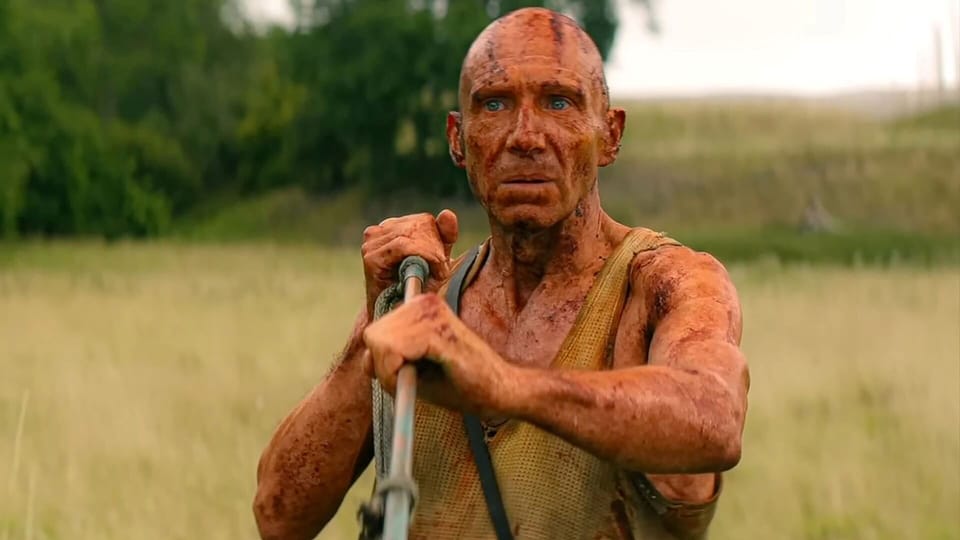
I've finally made it through enough of my backlog of 2025 releases to make a bold pronouncement: the top spot on my best of the year list goes to Danny Boyle's 28 Years Later.
I swear I'm not trying to be contrarian or provocative. There is just something deeply fascinating and artistically bold about what's happening with this 25-year-old sort-of-franchise and I'm increasingly concerned that far too few people are tapped into it. This was underscored for me when I went to see the latest film—28 Years Later: The Bone Temple—released just nine months after the last entry, in a nearly empty theater.
So I'm going to use my Bone Temple review to give you a bit of a primer on this strange series and try to convince you to overcome your fear of these extremely terrifying films so you can experience the beauty on the other side.
Here's what I watched this week:
- 28 Years Later: The Bone Temple, Nia DaCosta's bold entry into the 28 Years Later sub-trilogy
- No Other Choice, Park Chan-wook's brilliant dark comedy about an unemployed family man who will do anything to beat the competition
- Die My Love, Lynne Ramsay's stylish examination of a woman in crisis, featuring an incredible performance by Jennifer Lawrence
- A Matter of Life and Death, a 1946 fantasy drama about a WWII bomber pilot who escapes death due to a clerical mix-up in heaven
28 Days Later: The Bone Temple
The 28 Days Later franchise requires a bit of table setting. Not because of lore or world building—the films are mercifully light on that kind of baggage—but because of their strange production history.
In 2002, Danny Boyle (Trainspotting, Slumdog Millionaire, Sunshine) and writer Alex Garland (Civil War, Annihilation, Ex Machina) created 28 Days Later, a zombie movie for the modern era. Gone were George Romero's slow and shambling undead, replaced by ordinary humans infected with a "rage virus" who move spasmodically and with shocking speed.
Not only is 28 Days Later still the scariest film I've ever seen, it's also a stunning synergy of Boyle's unorthodox, punk-rock approach to visual storytelling and Garland's penchant for reflecting humanity at its worst. There's a distinctly post-9/11 quality to it. Shot on digital camcorders when the technology was still in its infancy, the film resembles the low-fidelity footage of human violence that was increasingly dominating the news in the new era of suicide bombings and global terror.
28 Days Later inadvertently kicked off the zombie media fad that dominated the mid-aughts well through the 2010s. The oversaturation of the genre, combined with the film being unavailable to purchase, rent, or stream for years due to issues with the rights undoubtedly hurt its legacy.
28 Weeks Later damaged its legacy even further. Released in 2007, it was made without the involvement of Boyle or Garland and the result is a decent but forgettable entry in the zombie movie canon. You don't have to watch 28 Weeks Later. It doesn't matter. I honestly worry that too many people think they've seen 28 Days Later but really they watched Weeks.
Twenty years pass. Boyle and Garland both experience commercial and critical success in their work. Boyle largely turns his back on the cynical tone of his early work (e.g. Trainspotting and Sunshine) in favor of more hopeful films like Slumdog Millionaire and Yesterday. Garland continues to write and direct bleak films about humanity and our destiny as a species and critics begin to wonder if he has run out of things to say.
With that background, you have every right to expect 2025's 28 Years Later to be a soulless attempt to cash in on a creative team's bygone glory.
28 Years Later is a stunning piece of filmmaking that explores what it means to continue living when everything else is gone. Set 28 years after the original—which you don’t even need to watch; there’s no sequel baggage here—we learn that the infection never spread beyond Britain’s shores. The world simply quarantined the island and moved on without it. Our protagonist is a young boy (Alfie Williams) raised in a small community that's managed to eke out an existence on a small tidal island in the north with a society that resembles medieval England.
The film begins as your standard survivalist zombie fantasy. The villagers have managed to survive by walling themselves off from the world around them and adopting a culture that embraces a nostalgic mythology of Britishness. It's clearly a commentary on post-Brexit Britain and the global trend to retreat into isolationism in search of an idyllic past that never really existed.
As the plot progresses and we move onto the mainland we're introduced to a world of stunning beauty and brutality. The infected have established themselves as part of the natural ecosystem, acting as predators and scavengers in a depopulated landscape where forests and grasslands have reclaimed pastoral northern England. There's undeniable beauty in this world, even if it's marred by a macabre horror.
Emphasizing all of this is some of the most inventive and stunning cinematography of recent memory. Danny Boyle, whose prior film was a light romp about "what if everyone forgot the Beatles existed?", returns to his roots as an anarchic filmmaker and the result is triumphant. The film is largely shot using iPhones that Boyle and his team cobbled together with cinema lenses and insane camera rigs to produce visual sequences incomparable with anything else I've seen on film.
The end product of all of this is a shockingly deep film about learning to cope with death. The climax of the film is an incredibly moving scene that celebrates life by embracing death. In the end it's a film about exposing yourself to the horrors of the world around you and finding a way through rather than retreating into yourself. There's so much beauty here and I wish I could tell you more but I honestly hope that some of you reading will decide to watch and experience it for yourself.
Which finally brings us to 28 Years Later: The Bone Temple. Shot simultaneously and released just seven months after the last, it represents Boyle and Garland handing the reins over to director Nia DaCosta (The Marvels, Candyman) to further explore this world they created. From a creative standpoint, there's something extremely cool about a director late in his career handing off a major part of his legacy to a younger director (and a woman of color) and giving her full creative freedom to work with. In an era of studio meddling and careful franchise management, it's deeply refreshing.
DaCosta's entry in the series manages to carry on the bold creative spirit of the last while being visually and tonally distinct. Picking up right where 28 Years finished, it follows Jack O'Connell and his band of depraved marauders who are all styled after a famous British pedophile as they terrorize the countryside. Ralph Fiennes reprises his role from the previous film that I don't want to tell you anything about for fear of spoiling the impact so I'll just say this: Fiennes' performance in these two films is my favorite of anything he's done and features the most impressive acts of tone management I've ever seen.
While it's overall a darker and much more violent film than the last, DaCosta manages to carry over Boyle and Garland's careful balance of tone and themes. Without spoiling it, I'll tell you that this movie includes pop music needle drops, dancing, and even a musical number. I will not be elaborating further. It's something you need to see for yourself.
If you are a person who can stomach horror films—and for all their beauty these do remain horror films—and you haven't locked into this series, I'm begging you to give 28 Years Later and The Bone Temple a watch.
No Other Choice
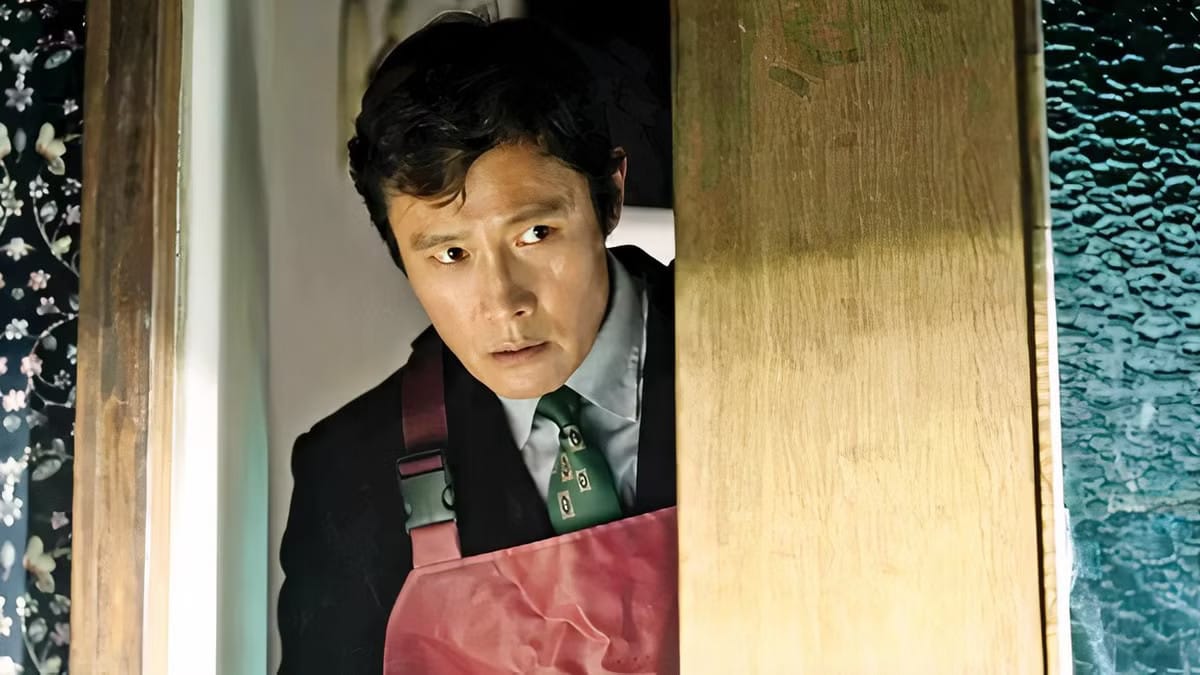
I knew Park Chan-wook's (Oldboy, Decision to Leave, Joint Security Area) No Other Choice was a dark social satire about life in an increasingly inhumane economic system, I just didn't expect it to be so damn funny.
No Other Choice follows Man-su (Lee Byung-hun), a proud family man whose livelihood and hard-earned life in the middle class is threatened when he's unceremoniously fired from his job as a factory manager at a paper company. As weeks turn to months and financial desperation mounts, he decides he has no other choice than to eliminate his competition in the dwindling job market by murdering them one-by-one.
What elevates No Other Choice is Park's sheer inventiveness with visual humor. There's a level of choreography going on, both with the actors and the camera, that's only comparable to Buster Keaton films. Park will set up a joke in dialogue and pay it off by moving the camera to reveal new information to the viewer. It's a sort of Looney Tunes humor that keep you laughing just long enough to realize that a man is about to commit an unspeakable act of violence for the sake of a paper job.
The social critique at the heart of the film is more nuanced than you might guess. Yes, it's a film about ever tightening labor markets and the existential threat of corporate consolidation and automation. But it's also a critique of the self-imposed pressures of masculinity, questioning if "going to war for your family" is a sane thing to consider doing.
Die My Love
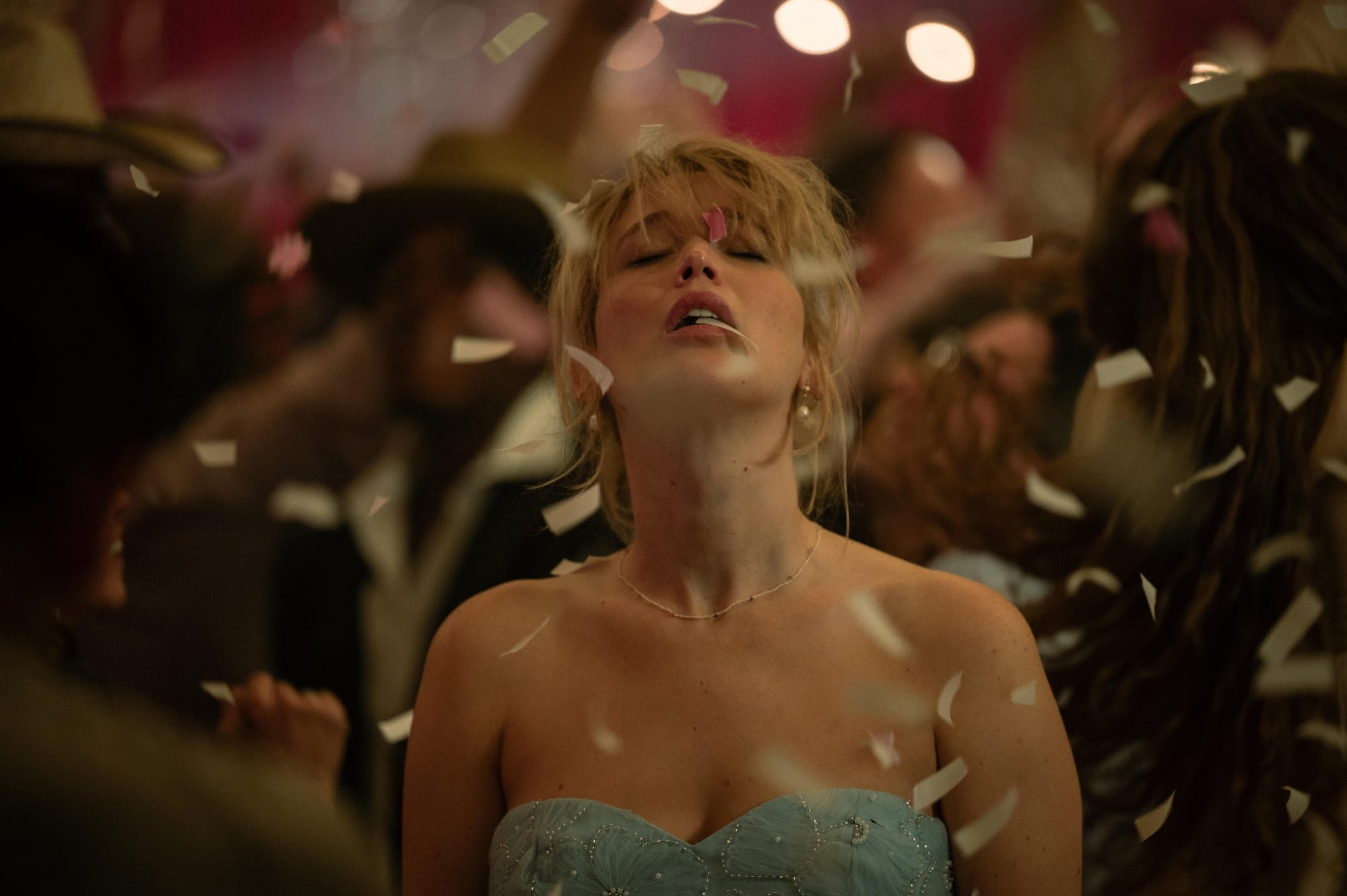
Lynne Ramsay's Die My Love, an adaptation of Ariana Harwicz's 2012 novel of the same name, is about a young mother struggling with something no one around her can seem to understand. It's a film that I appreciated while—and I write this fully aware of the irony—not fully understanding it.
It's the story of a woman brought to live in the countryside where her partner (Robert Pattinson) grew up, to bear and rear their child in isolation from the world. We see Lawrence's psyche fray in non-linear vignettes that depict the misery and increasing detachment of her daily reality.
From reviews by women—especially mothers—I've read online it's clear that Jennifer Lawrence captures the feeling of losing control of yourself and your reality in a way that's transcendentally raw and honest. The rawness and honesty is certainly something I can see—I'm deeply thankful we are living through the Lawrenaissance and her performance underlines her generational talent—but on a visceral level it's not a performance I can relate to. My first instinct is to blame this on my gender, project myself onto Pattinson's character who displays vague bewilderment but offers no proactive assistance. But I do wonder if some of Lawrence's character's interiority was lost in the translation from novel to screen.
The cinematography, however, I can praise unreservedly. Day scenes are shot with natural light that's slightly desaturated and cooled. There's just enough warmth to suggest that this place might once have been happy, but it's become washed out and jarring like a bright day when you haven't had enough sleep. Night scenes are realized with an exaggerated day-for-night effect, with a heavy blue filter that suggests night but the underlying light quality of bright sun. It lends a sense of surreality and suggests that days and nights are blending into one another.
For a film that I didn't fully vibe with, I still enjoyed Die My Love considerably. Lynne Ramsay has a talent for telling a story that's deeply tragic but never as depressing as the subject matter would seem to warrant. It's made me interested in exploring more of her work, which I plan to do because my favorite podcast will be covering her filmography for the next five weeks. I'll be interested how my opinions on this film will change by the time I'm done.
A Matter of Life and Death
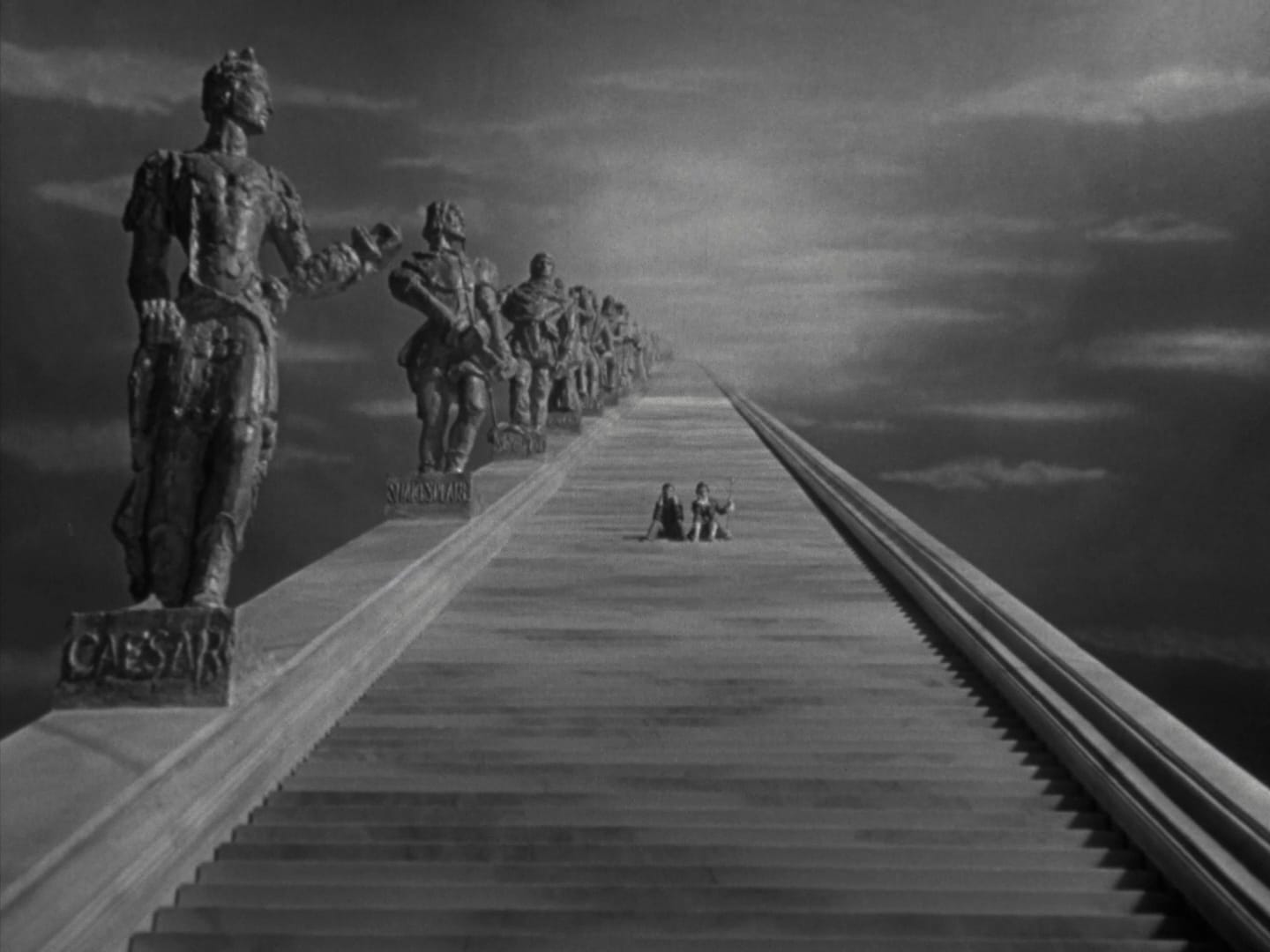
A Matter of Life and Death is a charming fantasy romantic drama with a shocking amount of visual flair. The film, released in 1946, concerns a British bomber pilot (David Niven) who bails out of his doomed plane without a parachute only to awaken on his home shore miraculously alive. He's soon informed by a representative from the afterlife—the film deftly avoids overt religious language and imagery—that there's been a mix-up and he's overdue. Having recently fallen in love, the pilot demands to stay on Earth. The matter escalates to a case before a heavenly court, with our hero's life in the balance.
The centerpiece of the film is in its visual presentation and what it tells us about the film's opinion on life and death. Scenes on Earth are shot in vibrant technicolor that looks absolutely gorgeous. The afterlife, however, is rendered in traditional black and white with sets that evoke austere modernism. It's not a bad place to be per se, but it lacks the warmth and qualities of living.
As I watched A Matter of Life and Death I realized just how many films and books have cribbed from its depiction of the afterlife: Pixar's Soul, Harry Potter and Dumbledore in an ethereal King's Cross, and 2025's Eternity—not to mention being directly quoted in Wes Anderson's The Phoenician Scheme. We now accept this modern, secular vision of heaven as a common motif, but in 1946 in the wake of a war that killed half a million British citizens it must have felt radical.
What held me back from truly loving this film are the parts that feel overly rooted in the time period. Much of the heavenly court case, the film's centerpiece, is devoted to debating Anglo-American relations and England's long list of enemies from its imperial past. I can appreciate how this would have been timely for an audience trying to come to terms with Britain's place in the postwar world, but it doesn't make for the most gripping drama 80 years later.
That being said, it's an engaging film that plays like an extended Twilight Zone episode with some truly impressive special effects. Give it a watch if that sounds enticing.
Thanks for reading and please consider coming to an upcoming showtime!
 Tyler Haas